
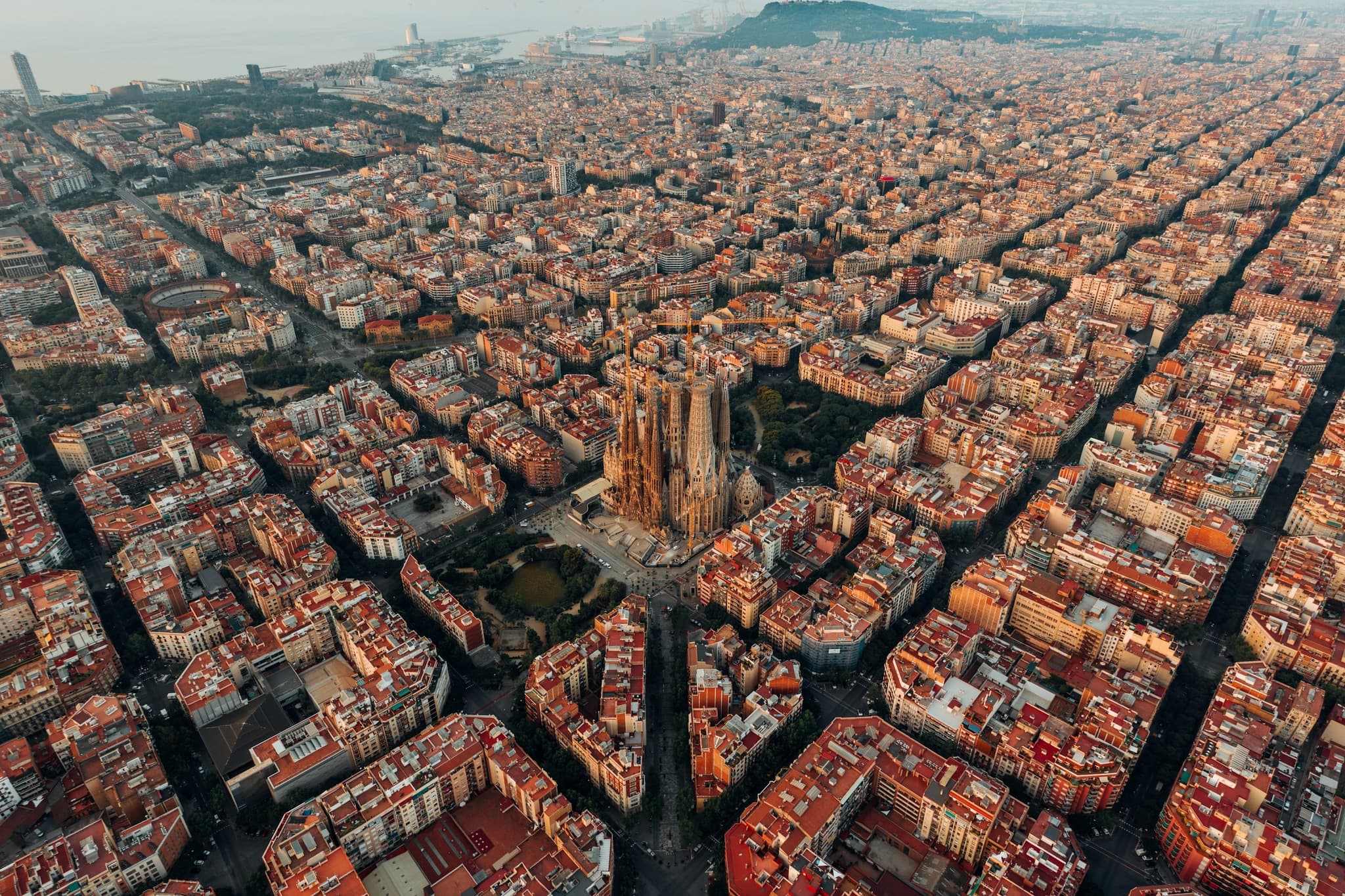
Living in Barcelona, Spain: City Profile for Foreign Nationals
Barcelona is the capital of the autonomous community of Catalonia and Spain's second-largest city. Located on the northeastern Mediterranean coast, it functions as a primary gateway to Europe and a major economic engine for the region. For foreign nationals, Barcelona offers a bilingual environment (Spanish and Catalan), a coastal lifestyle combined with intense urban density, and a highly competitive housing market.
City Overview and Demographics
The city limits of Barcelona house approximately 1.73 million inhabitants, while the greater metropolitan area exceeds 5 million. It is one of the most densely populated cities in Europe.
Demographics: As of early 2025, foreign nationals make up approximately 26.4% of the resident population. The city hosts over 180 nationalities, with the largest foreign communities originating from Italy, Colombia, Argentina, Pakistan, and China. Unlike other Spanish cities, Barcelona has a significant population of "digital nomads" and northern European remote workers, particularly in the central districts.
Districts and Housing Market
Barcelona is divided into 10 districts. The housing market is characterized by high demand and low supply, making it fast-moving. Apartments in popular areas often rent within 24–48 hours of listing.
Ciutat Vella (Old City)
Includes the Gothic Quarter, El Born, and Raval. It features historic architecture and high tourist density. Apartments are often smaller, older, and may lack elevators or natural light. Noise levels are high.
Eixample
The 19th-century expansion known for its grid layout and modernist architecture. It is the commercial and residential heart of the city, popular with affluent expatriates. Prices here are among the highest in the city.
Gràcia
Formerly a separate village, it retains a bohemian, pedestrian-friendly atmosphere with many plazas. It is highly popular with young professionals and artists but has a limited stock of available housing.
Sant Martí (Poblenou)
Located along the coast, this area has transformed into a tech hub (22@ district). It offers modern apartment blocks with terraces and communal pools, contrasting sharply with the older city center.
Sarrià-Sant Gervasi
The traditional upper-class district located near the mountains. It is quieter, greener, and features larger apartments and international schools, making it the preferred choice for families.
Average Rental Costs (January 2026 Estimates)
Rental prices in Barcelona are currently the highest in Spain. Landlords often request documentation proving a monthly income of at least 3x the rent.
Note: Currency conversions are calculated at an approximate rate of €1.00 = $1.04 USD.
- Studio / Small Loft: €1,100 – €1,300 ($1,144 – $1,352 USD) per month.
- 1-Bedroom Apartment (Central): €1,400 – €1,800 ($1,456 – $1,872 USD) per month.
- 2-Bedroom Apartment (Standard): €1,800 – €2,400 ($1,872 – $2,496 USD) per month.
- Room in Shared Flat: €550 – €800 ($572 – $832 USD) per month.
Public Transport (TMB & ATM)
Barcelona's transport system is integrated under the Autoritat del Transport Metropolità (ATM). The main operator is TMB (Transports Metropolitans de Barcelona). The city operates on a Zone system, but the entire municipality of Barcelona falls within Zone 1.
Metro and Tram
The Metro has 12 lines covering the city comprehensively.
Hours:
Sunday – Thursday: 5:00 AM – 12:00 Midnight
Friday: 5:00 AM – 2:00 AM
Saturday: 24-hour service
Ticket Options
Tickets can be purchased at machines in any station. Contactless payment (credit card) is available on buses and some metro turnstiles.
- T-casual: A multi-person card for 10 individual trips. It cannot be used by multiple people simultaneously on the same journey. Approx. €12.15 ($12.64 USD) for Zone 1.
- T-usual: A personal, non-transferable monthly pass allowing unlimited travel in the chosen zone. Approx. €21.35 ($22.20 USD) for Zone 1 (subject to government subsidies).
Labor Market and Economy
Barcelona's economy is distinct from Madrid's, with a heavier reliance on technology, tourism, and manufacturing logistics.
Key Sectors:
- Technology & Digital: The 22@ district in Poblenou hosts major offices for Amazon, Meta, and numerous startups. The city is a major hub for video game development and fintech.
- Tourism & Hospitality: A massive employer, though work is often seasonal.
- Biomedicine & Science: The city houses several top-tier research institutes and the Barcelona Supercomputing Center.
Language in the Workplace: While many international tech companies operate in English, speaking Spanish is generally required for local business. Knowledge of Catalan is highly valued and often mandatory for public sector jobs.
Administrative Locations for Foreigners
Bureaucracy in Barcelona is notoriously slow due to high demand. Appointments (cita previa) are required for all procedures.
Foreigners Office (Oficina de Extranjería)
- Rambla de Guipúscoa, 74: The main office for residency applications, TIE card issuance, and EU registry certificates.
- Calle Murcia, 42: Often used for asylum seekers and specific residency renewal procedures.
Municipal Registration (Empadronamiento)
To register your address, you must visit an Oficina d'Atenció Ciutadana (OAC).
Tip: Unlike some other cities, Barcelona allows you to start the application online if you have a digital certificate, though an in-person visit is often still required to finalize it.
Official Resources
Use these official channels to verify specific requirements or book appointments.
- Barcelona City Council (Ajuntament de Barcelona) – Official city portal for services and registration.
- TMB (Transports Metropolitans de Barcelona) – Maps, route planner, and ticket information.
- Cita Previa Extranjería – Government portal for booking immigration appointments.
- Rodalies de Catalunya – Information for regional commuter trains connecting to suburbs.